

From Foresight to Zeitgeist to Canvas: Roger Spitz’s 2019 'Metaruptions' Coinage Defines the Era of Systemic Change

Roger Spitz's Metaruptions - Painting by Dylan Gill
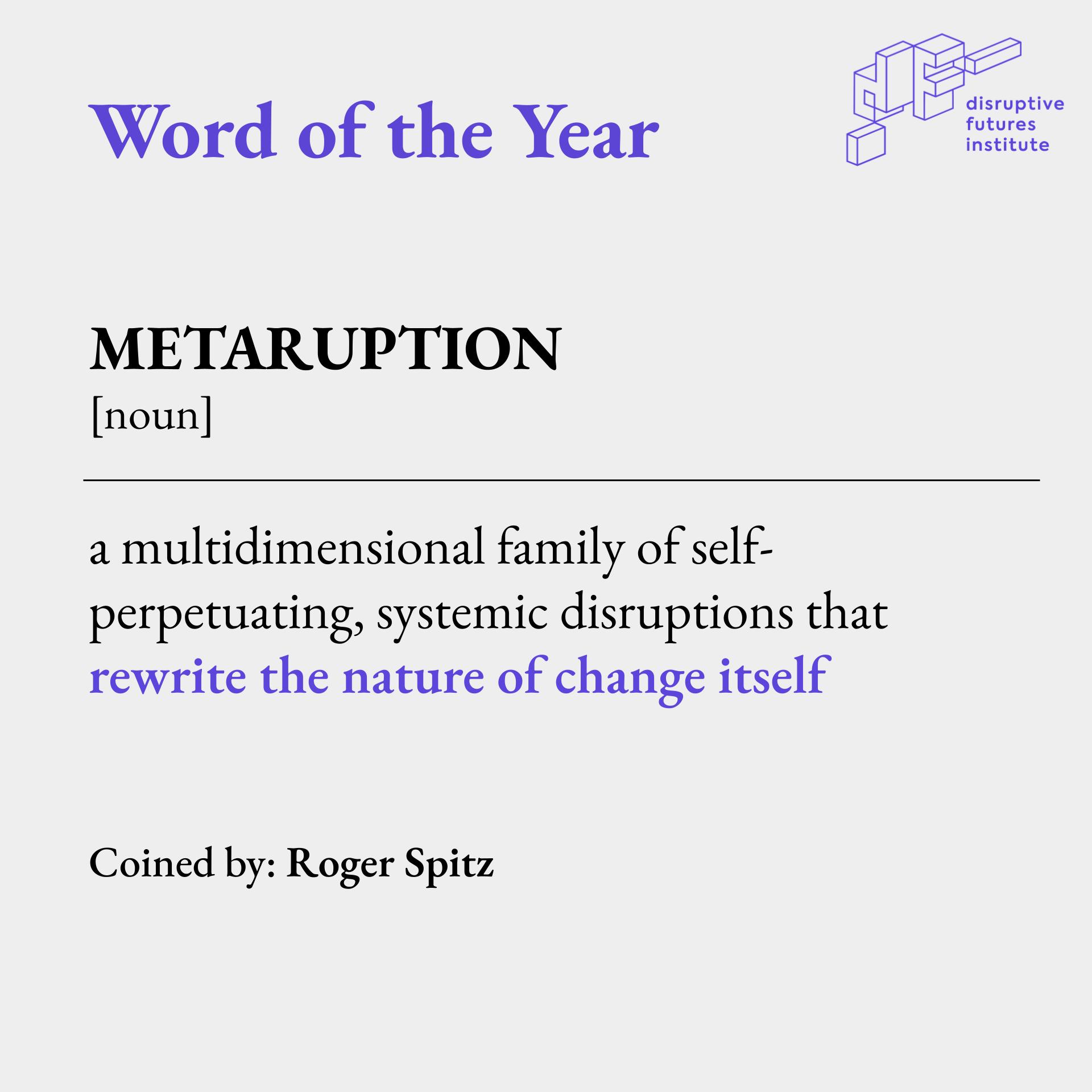
METARUPTIONS - Word of the Year (Disruptive Futures Institute)
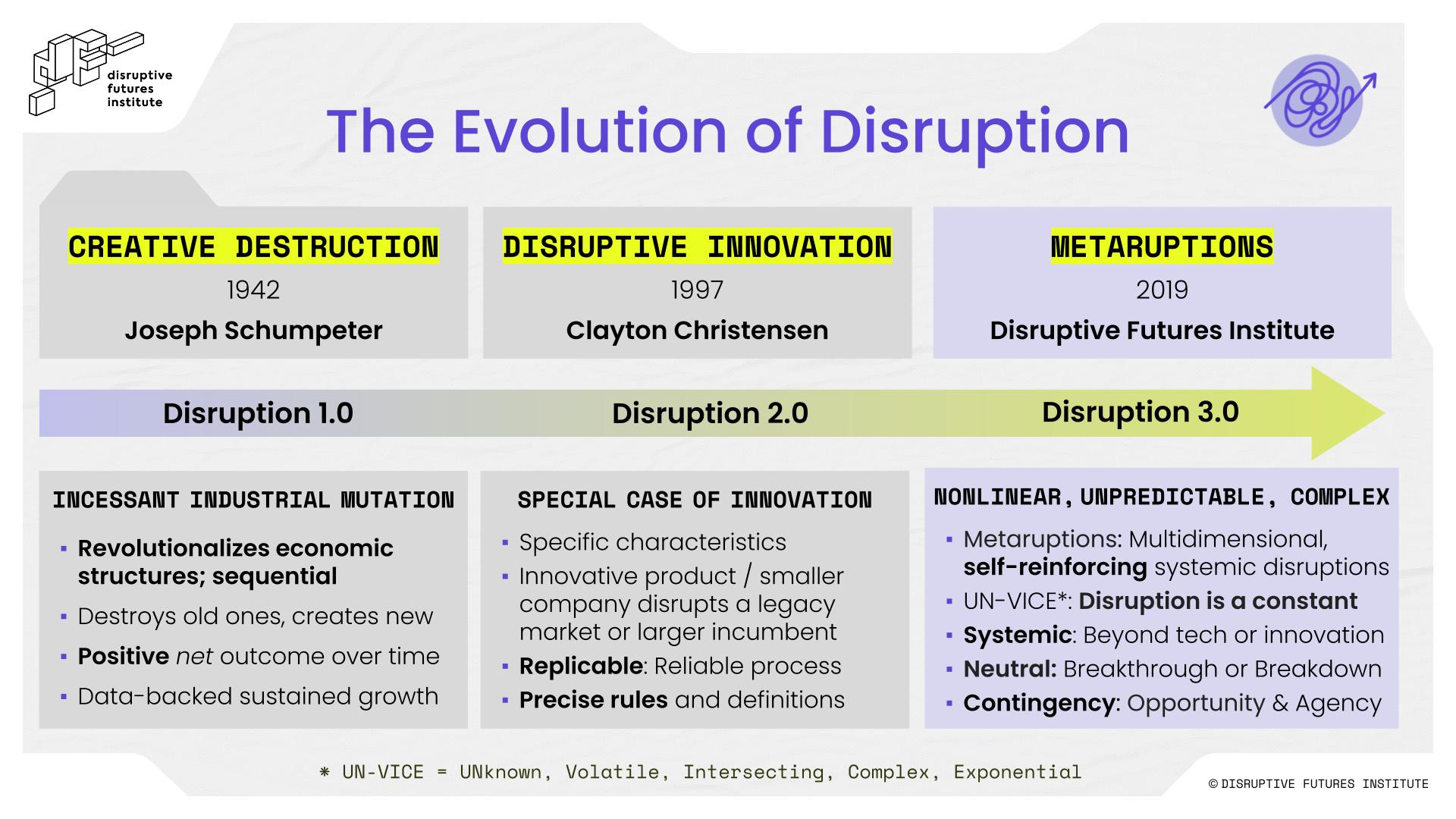
The Evolution of Spitz's Metaruptions

Roger Spitz's Metaruptions, Painting by Dylan Gill (Exclusive London TV Interview 2026)
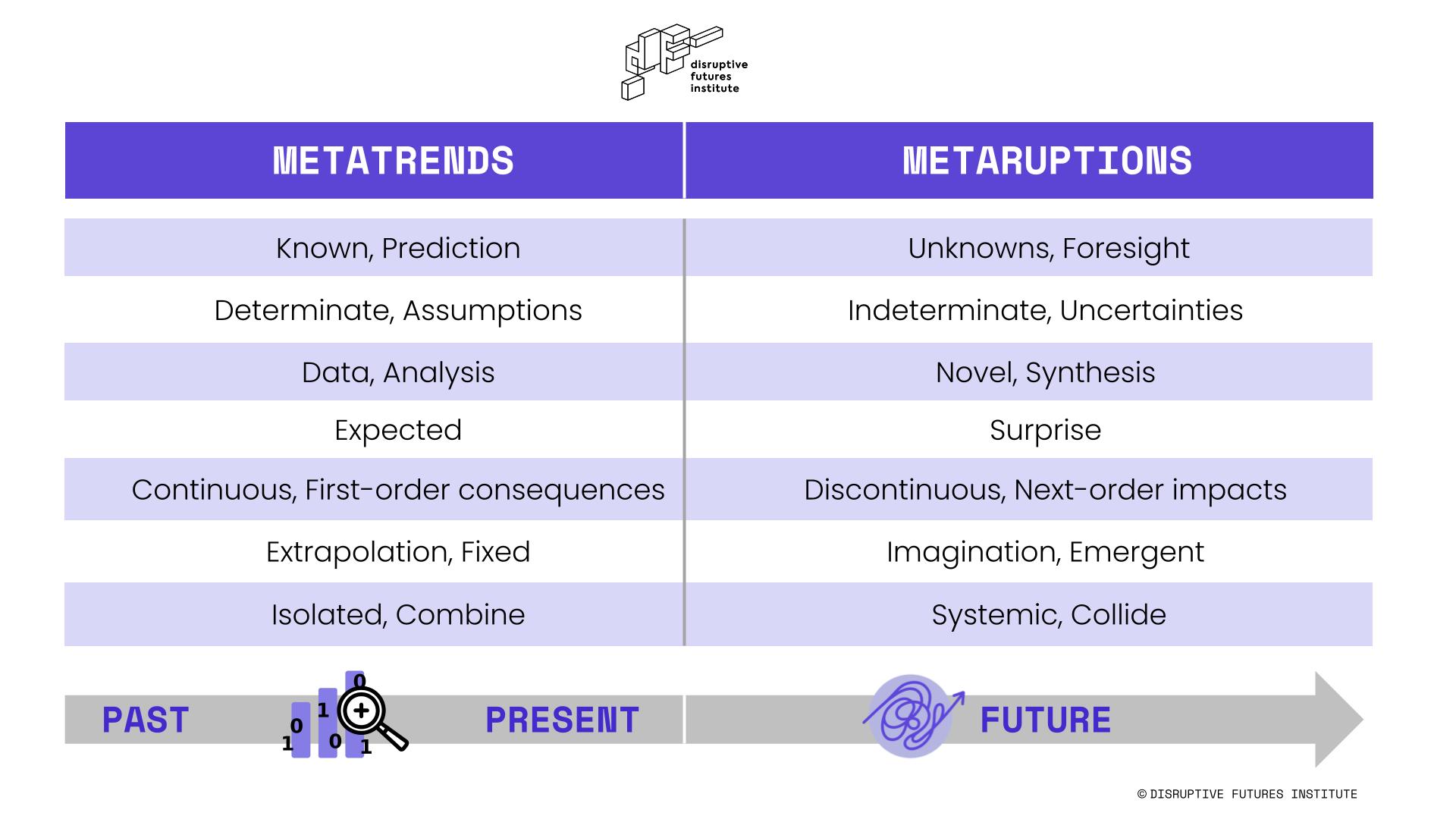
Metratrends vs Metaruptions (Roger Spitz, Disruptive Futures Institute)
A London TV Interview Unites Roger Spitz, Who Coined Metaruptions in 2019, with Artist Dylan Gill, Whose Neo-Cubist Painting Carries Spitz’s Term to Canvas
SAN FRANCISCO, CA, UNITED STATES, July 9, 2026 /EINPresswire.com/ -- The Disruptive Futures Institute (DFI) today released an exclusive broadcast interview recorded in a London TV studio: the first recorded conversation between Roger Spitz, the futurist who coined the term Metaruptions in 2019, and British contemporary artist Dylan Gill, whose created January 2026 Neo-Cubist painting based on the same name became an intuitive visual counterpart to Spitz’s concept.
Before the two had ever met, they had arrived at the same concept through radically different disciplines — one through strategic foresight, one through paint. The interview marks a new threshold in the trajectory of a term that has moved, over close to a decade, from foresight construct to the operating vocabulary of the era.
It was recorded during Spitz’s UK and European 2026 speaking and media tour, which included a series of keynotes, among them at Meta's Conversations 2026 in London in June 2026
THE LONDON BROADCAST INTERVIEW
Roger Spitz's Metaruptions, Painting by Dylan Gill | Exclusive London TV Interview. Watch the full Metaruptions painting interview:
• “Metaruptions: Roger Spitz in Conversation with Artist Dylan Gill (London Broadcast TV Studio)” on the Disruptive Futures Institute YouTube Channel:
• https://youtu.be/dCrwvmQGtzo
Metaruptions playlist on Disruptive Futures Institute YouTube Channel: https://www.youtube.com/playlist?list=PLWFVoVDSj97Y
A PROPHETIC COINAGE, EIGHT YEARS AHEAD
Roger Spitz coined the term Metaruptions in 2019, with the conceptual foundations first published in “The Future of Strategic Decision-Making,” Journal of Futures Studies (July 26, 2020) — subsequently formally codified and developed across his four-volume series “The Definitive Guide to Thriving on Disruption” (Disruptive Futures Institute, 2022–2023) and “Disrupt With Impact: Achieve Business Success in an Unpredictable World” (London: Kogan Page, 2024).
The chronology is noteworthy given the extent to which the world has since caught up. What Spitz identified in 2019 — that isolated trend analysis was collapsing as disruptions began propagating systemically across sectors, geographies, and time horizons simultaneously — is now the pervasive reality of 2026 and beyond, representing a new era of unpredictability. As Spitz puts it: “Leaders long clung to trends as the currency of foresight. Metaruptions reveal change as a networked force: combinatory, exponential, and boundaryless. What were once perceived as provocative constructs are now the pervasive reality of the decade.”
WHAT ARE METARUPTIONS?
From Latin rumpere — to rupture, erupt, interrupt, disrupt — prefixed with meta (Greek/Latin: beyond, after, transcending). A portmanteau of disruption and meta: disruptions that transcend, fold back upon themselves, intersect, and ultimately disrupt the very notion of disruption.
Metaruptions are a multidimensional family of systemic disruptions generating widespread, self-perpetuating effects that extend far beyond their initial domains — including shifts in the very notion of disruption itself. Metaruptions are not isolated events but networked forces operating within complex systems: they interact, amplify, and cascade nonlinearly across geographies, sectors, and time horizons, producing emergent phenomena that no single component could have predicted. Their most consequential impacts are typically second- and third-order effects — the places where disruptions from apparently unrelated domains collide and generate something entirely new: a new field, a new vulnerability, a new form of possibility that the existing taxonomy of knowledge has no ready place for.
Importantly, metaruptions are value-neutral. They lead to breakdown or breakthrough depending on agency, mindset, preparation, and response.
FROM CONCEPT TO GLOBAL ZEITGEIST
By 2026, Metaruptions had gained meaningful traction beyond specialist foresight circles. Forbes contributor Dr. Nadya Zhexembayeva designated “Metaruption” a Word of the Year for 2026, framing it as the essential lens for understanding the modern landscape of compounding systemic change; Forbes Japan subsequently translated the piece for Asian leadership audiences. The term now frames the 2026 edition of the Toolkit published by the International Training Centre of the ILO (ITCILO), the training arm of the United Nations’ International Labour Organization for the future of work. Over the same period, Metaruptions has been referenced across the UK National Preparedness Commission, the CFA Institute, IDOS (German Institute of Development and Sustainability), the Association of Professional Futurists, MIT Technology Review Brasil, Kirkus Reviews, and broadcast coverage including CNN Brasil.
Each of these references arose independently — across media, policy, academia, the professions, and now art: a term coined in 2019 now adopted independently across fields, geographies, and organizations.
WHEN FORESIGHT MEETS ART
The London interview extends that adoption into cultural discourse. Dylan Gill, a prominent London-based contemporary artist working in modern Neo-Cubism, discovered the word while searching for a one-word title for his painting — a canvas holding surveillance cameras, ecological thresholds, screen-mediated emotion, and the clash of technological shock against systemic calm in a single frame. In the interview, the two unpack the painting’s symbology, why terms like polycrisis and megatrends fall short, and why imagination — not extrapolation — is what navigating systemic change requires.
“It was absolutely great chatting with Roger in London and diving into the ideas behind my painting ‘Metaruptions,’ it’s rare to unpack a piece with the very person who coined its title. Our conversation was a brilliant look at how art can capture systemic disruption.” — Dylan Gill, Artist
The full interview and accompanying excerpts are available on the Metaruptions playlist on the Disruptive Futures Institute YouTube channel: https://www.youtube.com/playlist?list=PLWFVoVDSj97Y
THE AAA FRAMEWORK: OPERATIONALIZING METARUPTIONS
To address the systemic challenges and opportunities of Metaruptions, the Disruptive Futures Institute developed the proprietary AAA Framework, introduced in Spitz’s 2020 seminal Journal of Futures Studies article on The Future of Strategic Decision-Making. It equips organizations and leaders with the capabilities to be future-prepared in the face of compounding systemic shocks: Antifragile — building systems that gain strength from volatility and disorder; Anticipatory — scanning weak signals, questioning assumptions, and preparing for multiple futures; and Agility — creating the cognitive, emergent, and strategic agility, for the flexibility to bridge long-term vision with real-time pivots. The AAA Framework has been adopted and referenced internationally, including in a Global Foresight Network case study of Lux Carbon Standard (Brazil) applying the framework to transform carbon markets.
“Scenarios were never enough,” Spitz said. “Metaruptions are value-neutral — breakdowns or breakthroughs are determined by perspective and preparedness, not inevitability.”
For media inquiries and interviews: media@disruptivefutures.org
For speaking inquiries, or to view Roger Spitz’s speaker reel and book a keynote: https://www.disruptivefutures.org/speaking
###
APPENDIX: MEDIA BRIEFING NOTES FOR EDITORS
This briefing pack from Roger Spitz and the Disruptive Futures Institute’s body of work provides contextual materials and provenance for editors and partners covering Metaruptions and the London broadcast interview.
METARUPTIONS DEFINED
• Etymology: A portmanteau of the prefix “meta” (beyond/transcending) and the Latin rumpere (to rupture or erupt).
• The Concept: A multidimensional family of systemic disruptions that are self-reinforcing and self-perpetuating, extending far beyond the initial event.
• The Distinction: Unlike “trends” or “megatrends,” which rely on linear extrapolation, Metaruptions identify the meta-layer of change — where disruptions begin to disrupt the very frameworks we use to understand them.
• The Mechanism: As initial changes spill over, their impacts combine and propagate, ultimately disrupting disruption itself.
• Value-Neutrality: Metaruptions are not inherently negative or positive; they are dynamic processes whose outcomes (breakdown or breakthrough) are largely determined by agency, perspective, preparedness, and response.
• Provenance: Coined by Roger Spitz in 2019 and formally codified in the Disruptive Futures Institute’s 2020–2024 body of work.
THE VOCABULARY PROBLEM: WHY SPITZ DEVELOPED THE CONCEPT
Language does not merely describe the world. It shapes what the world permits us to think. The twenty-first century has been generating phenomena for which inherited vocabulary is inadequate. Polycrisis names the accumulation and interaction of simultaneous crises, but does not conjure a posture for navigating them. Permacrisis declares the emergency permanent — which is another way of declaring it beyond response. Both terms are analytically useful, but they flatten agency from the narrative at the precise moment when the capacity to respond matters most.
Megatrends fails differently. Trend reports extrapolate the past into the future, assume the underlying structure holds, and project forward from what can already be seen. They present unrelated shifts as though they interact predictably, rarely accounting for second- or third-order consequences, and create a false sense of comfort, clarity, and knowability in conditions that deserve none. Megatrends map direction. Metaruptions describe collisions, which may never become visible before they happen. With Metaruptions, we must ask what lies beyond what we can currently see.
While terms like Polycrisis and Permacrisis frame the world through a lens of perpetual disaster, Metaruptions are inherently value-neutral: the raw mechanics of systemic change, leading to either breakdown or breakthrough based on our agency, mindset, preparation, and response.
THE EVOLUTION OF DISRUPTION: A DOCUMENTED LINEAGE
Metaruptions occupy a specific position in the evolution of disruption thinking, demonstrating a consistent, multi-year lead over ongoing adoption of the concept:
DISRUPTION 1.0 — Creative Destruction (Joseph Schumpeter, 1942)
• The Mechanism: Institutional or industrial shifts replacing old paradigms.
• The Focus: “Incessant industrial mutation” — the new economy destroying the old to move forward.
DISRUPTION 2.0 — Disruptive Innovation (Clayton Christensen, 1997)
• The Mechanism: Entrant-incumbent innovation dynamics within specific sectors, markets, or products.
• The Focus: Agile challengers displacing legacy players through replicable, analyzable processes.
DISRUPTION 3.0 — Metaruptions (Roger Spitz, 2019)
• The Mechanism: Omnipresent, multidimensional, systemic change in which disruptions cascade, intersect, and generate emergent effects far beyond original domains.
• The Focus: Nonlinearity and UN-VICE (UNknown, Volatile, Intersecting, Complex, Exponential). Impact cascades across sectors, geographies, paradigms, and time horizons — requiring a new operating system for agency, hope, and decision-making in unpredictability.
Earlier frameworks reasonably assumed the underlying system was stable enough to analyze. Metaruptions extend the lineage into conditions those frameworks were not designed to navigate: systemic complexity, nonlinear dynamics, and emergent interactions in which the framework for analysis is itself subject to disruption. The AAA Framework offers a basis for future-preparedness and resiliency in the context of metaruptions.
A WIDENING RECORD OF INSTITUTIONAL ADOPTION
Over the past couple of years, Metaruptions has appeared across independent media, policy, academic, professional, and cultural contexts, including:
• Forbes (US and Japan): “Metaruption” designated a Word of the Year for 2026 by contributor Dr. Nadya Zhexembayeva (January 2026), subsequently translated by Forbes Japan.
• Institute and Faculty of Actuaries (IFoA), The Actuary: Spitz’s article “Creature discomforts: categorising risks amid deep uncertainty” (July/August 2026 issue), applying metaruptions and the AAA Framework to risk and deep uncertainty in the actuarial profession.
• International Training Centre of the ILO (ITCILO): Futures Toolkit (2026), developed with foresight studio Pantopicon and freely available under a Creative Commons license, opens by situating 2026 through the metaruptions term — language that traces to Spitz’s original definition.
• World Economic Forum: Spitz’s agenda forum contributions on the shift from prediction to foresight and on anticipatory governance, and a Global Foresight Network case study (Lux Carbon Standard, Brazil) applying the AAA Framework.
• National Preparedness Commission (UK): referenced in work on systemic resilience and the shift from prediction to strategic foresight.
• IDOS (German Institute of Development and Sustainability): Policy Brief No. 24/2024 (Klingebiel & Baumann), applying the term to geopolitical analysis.
• CFA Institute (Enterprising Investor): referenced in analysis of scenario planning under deep uncertainty.
• Association of Professional Futurists (APF), Compass Magazine: engaged by Jim Dator and James Holcombe.
• MIT Technology Review Brasil: Spitz’s column on “metadisrupções.”
• Kirkus Reviews: on Disrupt With Impact.
• Broadcast and media coverage, including CNN Brasil.
• Cultural discourse: London-based artist Dylan Gill's January 2026 Neo-Cubist work Metaruptions, and the first recorded conversation between Gill and Spitz (London, 2026).
SELECTED THIRD-PARTY CITATIONS
“Spitz is particularly compelling on the concept of the ‘metaruption,’ which he describes as ‘a multidimensional family of systemic disruptions, including shifts in the notion of disruption itself.’ These ‘metaruptions’ defy all the rules, and here, as elsewhere, the author itemizes the opportunities that can accompany the ‘unparalleled messiness’ of change.” — Kirkus Reviews, on Disrupt With Impact
“While Roger Spitz mentions John Naisbitt’s notion of megatrends as an earlier awareness of a polycrisis, he makes a convincing case for the concept of a ‘metaruptions’ instead.” — Jim Dator, “Thoughts on Thoughts About the Polycrisis,” APF Compass Magazine, April 2025
“The term ‘metaruptions’ describes a multidimensional family of systemic disruptions with widespread and self-perpetuating effects.” — From Prediction to Strategic Foresight, National Preparedness Commission (UK)
SELECTED SPITZ QUOTES FOR PRESS
• “The question is no longer whether we face Metaruptions — but whether we meet them by design or by surprise.”
• “By naming the phenomenon, we reclaim agency. We move from being surprised and disrupted to becoming architects of adaptive systems.”
• “Imagining the interplay of metaruptions is a creative endeavor, not a number-crunching exercise.”
• “Networks of disruption aren’t threats to avoid — they are realities to navigate. Preparedness, optionality, and adaptability define success.”
• “Metaruptions cause widespread and self-perpetuating effects that extend beyond their initial disruptions.”
• “Metaruptions defy rulebooks. We must envision the questions to be asked - and delve into the questions behind the questions.”
METARUPTIONS PROVENANCE: PRIMARY PUBLICATIONS BY ROGER SPITZ, WHO COINED THE TERM IN 2019
Roger Spitz coined the term Metaruptions in 2019. The publications below constitute the primary record in which he defined and developed the concept, from its first conceptual foundations through its formal codification across his books and articles. In parallel, he has explored and developed Metaruptions across keynotes, media interviews, television, and podcasts worldwide.
• Spitz, R. “The Future of Strategic Decision-Making.” Journal of Futures Studies, July 26, 2020.
• Spitz, R., The Definitive Guide to Thriving on Disruption, Vols. I–IV. Disruptive Futures Institute: San Francisco, 2022–2023.
• Spitz, R. The Definitive Guide to Thriving on Disruption: Vol. I. Reframing and Navigating Disruption. Disruptive Futures Institute: San Francisco, 2022.
• Spitz, R., The Definitive Guide to Thriving on Disruption: Vol. II. Essential Frameworks for Disruption and Uncertainty. Disruptive Futures Institute: San Francisco, 2022.
• Spitz, R., The Definitive Guide to Thriving on Disruption: Vol. III. Beta Your Life: Existence in a Disruptive World. Disruptive Futures Institute: San Francisco, 2023.
• Spitz, R., The Definitive Guide to Thriving on Disruption: Vol. IV. Disruption as a Springboard to Value Creation. Disruptive Futures Institute: San Francisco, 2023.
• Spitz, R. Disrupt With Impact: Achieve Business Success in an Unpredictable World. Kogan Page: London, 2024.
• Spitz, R., and Choi, D. “Metaruption: Understanding the Complexities of a Disrupted World”. Homo Dongmicus, November 11, 2024.
• Spitz, R. “Why shifting from prediction to foresight can help us plan for future disruption.” World Economic Forum, May 3, 2024.
• Spitz, R. “Polycrisis or Polyprepared? Welcome to Metaruptions”. Compass Magazine, April 2025: Welcome to the Polycrisis. Association of Professional Futurists (APF), April, 2025.
• Spitz, R. “Foresight is Dead. Long Live Foresight.” Compass Magazine Special Edition, APF and the Global Futures Society (GFS), November 2025.
• Spitz, R. “Policrise ou Polipreparação? Conheça as metadisrupções.” MIT Technology Review Brasil, August 26, 2025.
• Spitz, R. “Creature discomforts: categorising risks amid deep uncertainty”. The Actuary, July 8, 2026.
Media Contact
Disruptive Futures Institute
email us here
Visit us on social media:
LinkedIn
Instagram
YouTube
X
Other
ROGER SPITZ OFFICIAL SPEAKER REEL 2026
Legal Disclaimer:
EIN Presswire provides this news content "as is" without warranty of any kind. We do not accept any responsibility or liability for the accuracy, content, images, videos, licenses, completeness, legality, or reliability of the information contained in this article. If you have any complaints or copyright issues related to this article, kindly contact the author above.
